
JNCC MMO eLearning
Joint Nature Conservation Committee (JNCC) Marine Mammal Observer Mitigation Training
Instant Access eLearning Course – Cost £150
Trainer: Alison Gill BSc, MSc

Book here for the eLearning JNCC MMO Course
eLearning Course – £150
Please click on the above image to register and pay for this course. By registering for this course you agree to Intelligent Ocean’s Privacy Policy which can be downloaded here. On the next page click on the words “Click here to register” and fill in the registration form. Please enter the exact name you want on your course certificate in this registration form. You will then see a page with this course listed. Click on the “Buy” button and this will take you through to a payment page. After payment you will see your purchased course in your course list. Simply click on the title and you can start the course.
Please note that if you have previously purchased another course then you just need to log in with your username and password, click on the catalogue tab and then select this JNCC MMO course to purchase.
Important – Please read Terms and Conditions before booking
If you are an employer and wish to sign up your staff for this course, please email us at support@intelligentocean.com for registration and invoicing details.
PLEASE NOTE WE OFFER REFRESHER COURSES TO THOSE PERSONS WHO WISH TO UPDATE THEIR CURRENT CERTIFICATE.
REFRESHER COURSES COST GBP £75
EMAIL US FOR DETAILS SUPPORT@INTELLIGENTOCEAN.COM
Course Details

This Joint Nature Conservation Committee (JNCC) registered course is required for you to work as a Marine Mammal Observer (MMO) in UK Continental Shelf waters during offshore projects such as seismic surveys, pile-driving and projects involving the use of explosives.

Simply log in, read, learn and complete course assessments at your own pace. Simple design, easy to navigate pages (see example pages below). Assessments can be retaken if you don’t achieve the pass mark first time. Just restudy the course content. You set the pace of your learning.
The course programming is designed to work best on laptop and desktop computers. While you can view this course on mobile phones and tablets we cannot guarantee that the formatting will work on these devices.
Please note that this eLearning format is approved by the JNCC and the certificate that will be issued on completion has the same validity as those received after the classroom taught courses.
Please note the JNCC do not require these JNCC MMO mitigation training courses to have practical elements. Intelligent Ocean caters for persons who already have practical experience or encourages those who have yet to gain this experience to seek suitable fieldwork or specialist identification courses to achieve this. This online course has sections with advice on how to gain more experience.
You will have continued access to this course content for 3 years. After this time, you will have the option to renew for another 3 years for a small fee and have continued access. We will be updating the course content when regulations change and adding additional relevant material. This will be a good resource for any working professional.


The course contents are as follows:
-
Introduction to the biology and sensory world of marine mammals.
-
Potential impacts of man-made noise on marine mammals.
-
Discussion on the basis for current legislation in place for the UK to protect marine mammals during industry operations and the organisations involved.
-
Industry operations that have the potential to cause injury or disturbance, outlining the operational procedures of each one.
-
An in-depth explanation of the mitigation measures proposed for each project.
-
MMO mitigation data forms and report compilation.
-
Marine mammal identification – how to visually spot and identify animals in the field.
-
Marine mammal survey techniques and range estimation.
-
Introduction to passive acoustic monitoring.
-
Life onboard vessels or platforms as an MMO – expected conduct of working with industry personnel.
-
Course assessments with a pass mark of at least 85% required.
Example pages from the eLearning course
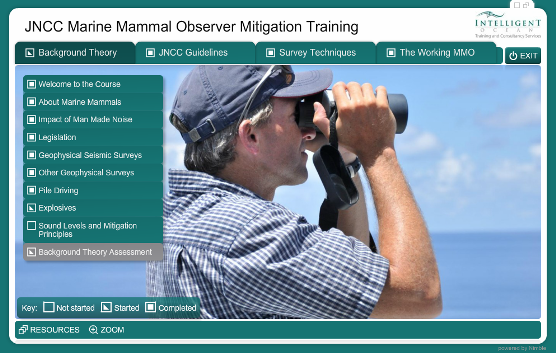
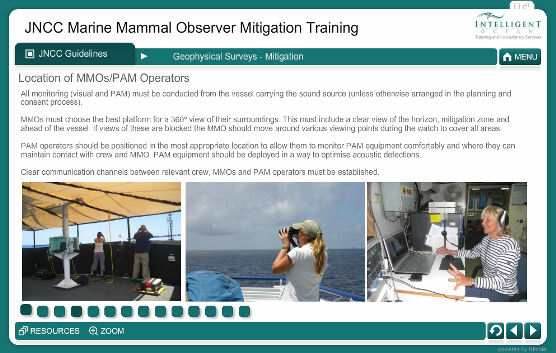
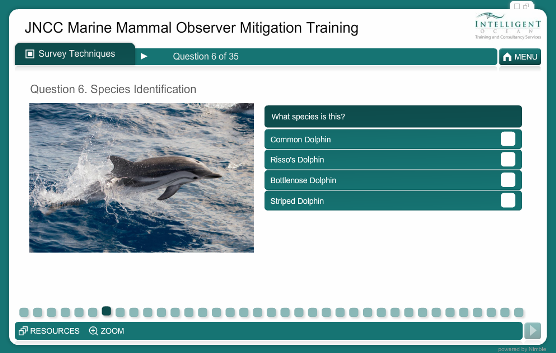
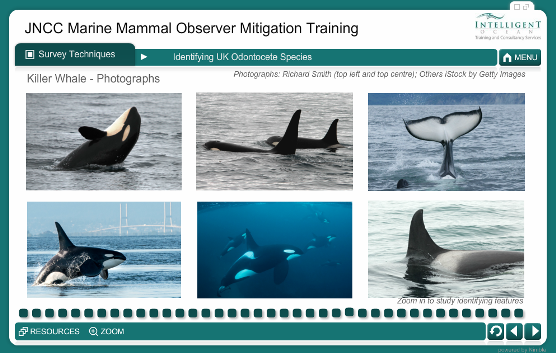
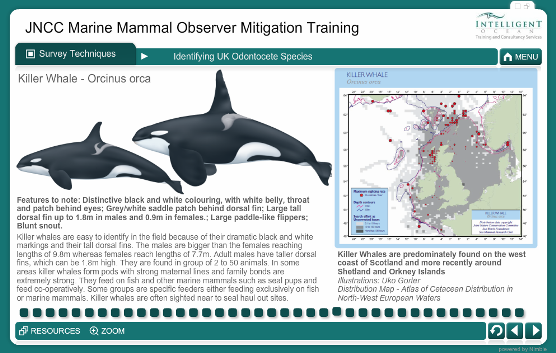
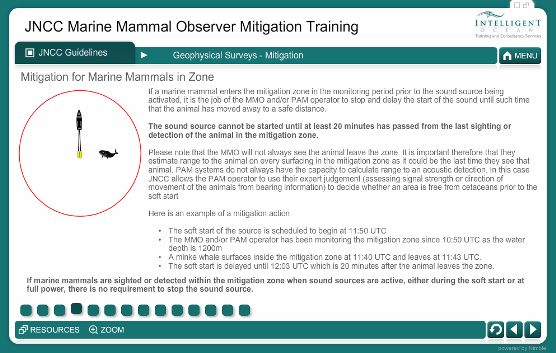
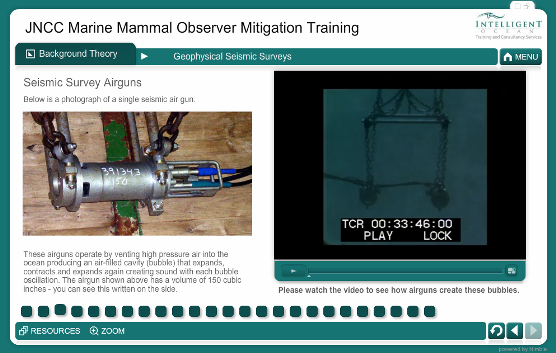
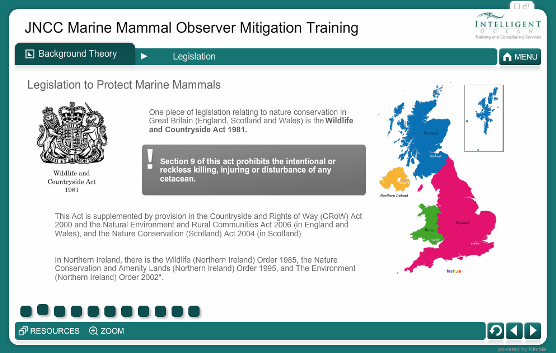
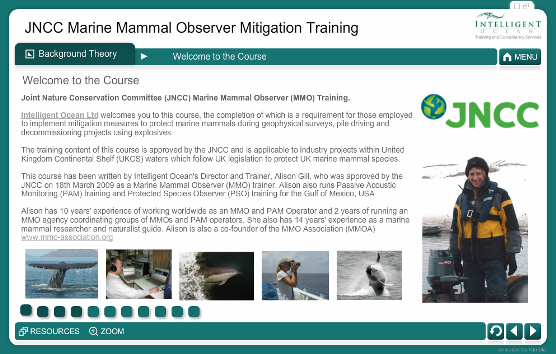
* Please note that persons likely to win contracts working as MMOs are those who have additional biological or environmental qualifications and/or have experience of working at sea. To work as an MMO in some areas of the UK where marine mammals are more abundant you will be required to have experience of working with marine mammals whether this is formally as a researcher, previous employment or through voluntary work.
We would expect that persons wishing to work as MMOs to already have this experience or will endeavour to do so after this course. Alternatively you may be personnel from the offshore industry sector who may like to complete an eLearning course in order to gain more knowledge of marine mammal observation during offshore operations.
Important – Please read Terms and Conditions before booking
Ready to Start Learning?
Privacy Policy
Intelligent Ocean's privacy policy regarding personal data held in order to provide training services can be downloaded at the link below. By purchasing our training services you agree to this policy.
Intelligent Ocean's Privacy Policy can be downloaded here.
Access to Courses
We will endeavour to allow uninterrupted access to your eLearning material, but access to the courses may be suspended, restricted or terminated at any time. We reserve the right to change, modify, substitute or remove without notice any information in the material from time to time.
You will have access to the courses you have purchased for 12 months from the date of purchase. You will be able to have further access after the 12 months on payment of a renewal fee.
Language
Trainees must be able to speak, read and write fluently in English.
Intellectual Property/Copyright
The copyright in the material contained in the courses, together with the design, text and graphics and all software compilation belong to INTELLIGENT OCEAN LTD. All rights are reserved. None of this material may be reproduced or redistributed without INTELLIGENT OCEAN LTD's written permission. You may, however, download or print a single copy for your own non-commercial viewing.
If you download the course material from our site, all the material and data are deemed to be licensed to you by INTELLIGENT OCEAN LTD, for your personal, non-commercial use only. INTELLIGENT OCEAN LTD does not transfer either the title or the intellectual property rights of the course and INTELLIGENT OCEAN LTD retains full and complete title to the courses as well as all the intellectual property rights therein. You may not sell, redistribute or reproduce or convert any of the material. INTELLIGENT OCEAN LTD owns all trademarks and logos and you may not copy or use them in any manner.
Exclusions of Liability
INTELLIGENT OCEAN LTD will use reasonable endeavours to ensure that the data in the courses is accurate and to correct any errors or omissions as soon as practicable after being notified of them. To the extent permitted by applicable law, we disclaim all warranties and representations (whether express or implied) as to the accuracy of any information contained in the courses. We do not guarantee that the material will be fault free and do not accept liability for any errors or omissions.
We do not give any warranty that the website is free from viruses or anything else, which may have a harmful effect on any technology. INTELLIGENT OCEAN LTD makes no representation whatsoever regarding the content of any other websites, which you may access from the courses. A link to a non-INTELLIGENT OCEAN LTD website does not mean that INTELLIGENT OCEAN LTD endorses or accepts any responsibility for the content or use of such websites.
Cancellations
Once you have booked onto an eLearning course you have up to 14 days from the purchase date to cancel your booking and receive a full refund provided that the eLearning has not been accessed. After the 14 days, or if the eLearning has been accessed you will not be entitled to any refund, nor will you be able to transfer your eLearning to another person or onto another eLearning course.
Passwords
You should register for online purchasing after clicking the 'buy now' link. You will use your email address and password to gain access to your courses.
Your login details are the methods used by us to identify you and so are very important. Any information regarding someone using your password details should be advised to the INTELLIGENT OCEAN LTD office immediately.
PAM ELearning Course
For PAM training each trainee will be required to use a PC computer. Please note that MAC computers tablets and mobile phones are not suitable for the PAM course. The course material and practical exercises will assume that you have a PC and the commands will be written for PCs using windows.
Certificates and Registration (if applicable)
On completion of a course, a certificate will be issued. If the course is an accredited course the trainee's contact details will be sent to the accrediting body (if applicable) to register that they have completed the training as this is required for their databases. Trainee details will not be used for any other purpose.
Identity and Misuse
INTELLIGENT OCEAN LTD holds no responsibility for misuse of identity when registering for our eLearning courses. The name given on registration will be the name on the certificate of completion and it is assumed that the person, whose identity this is, has completed the training course. Any employer who purchases these courses for their staff will hold the responsibility for ensuring that there is no breach of identity.
Satisfactory Completion of Course
Modifications to Terms and Conditions
We may modify these terms and conditions at any time by publishing the modified terms and conditions on the website.
Updates by Regulators
INTELLIGENT OCEAN LTD cannot be held responsible for any government regulator upgrading training requirements in the future which will result in personnel having to attend further training to upgrade their current certificate.
